
September 11, 2026
New blog post on certifying uncontrollability
A new essay explains how infeasibility certificates from convex optimization can rapidly prove that a desired state-space maneuver cannot be reached.
Hey, I’m Ahmad
I work on dynamic system science, control, networks, and infrastructure, and I write papers with mostly my students —
This site also holds the more personal side of things: writing, food, travel, and other interests that matter to me —

Recent papers, teaching updates, travel notes, and announcements from the past year.
September 11, 2026
A new essay explains how infeasibility certificates from convex optimization can rapidly prove that a desired state-space maneuver cannot be reached.
September 2026
Two recent works are now available as preprints: one accepted for publication in IEEE Transactions on Intelligent Vehicles, and one conditionally accepted for publication in IEEE Transactions on Automatic Control.
September 2026
The new Infrastructure Systems Engineering course page includes the syllabus, the first two modules, and the first two homework assignments. More course content will be added as it is developed.
August 2026
A long-form piece on reduced-order models, compression, language, fashion, infrastructure, and the cost of throwing away hidden modes.
August 2026
An earlier offering of the class is now available online for anyone who wants a preview of the material.
August 2026
A new post collects some thoughts from the summer and a gallery of pictures from the trip.
August 2026
The paper develops a large-scale optimization model for multimodal transportation networks.
July 2026
A new conference paper on anomaly detection appeared at the International Conference on Machine Learning. Congrats, Yilin.
July 2026
This work proposes a new way to quantify observability in nonlinear systems after a very long review journey.
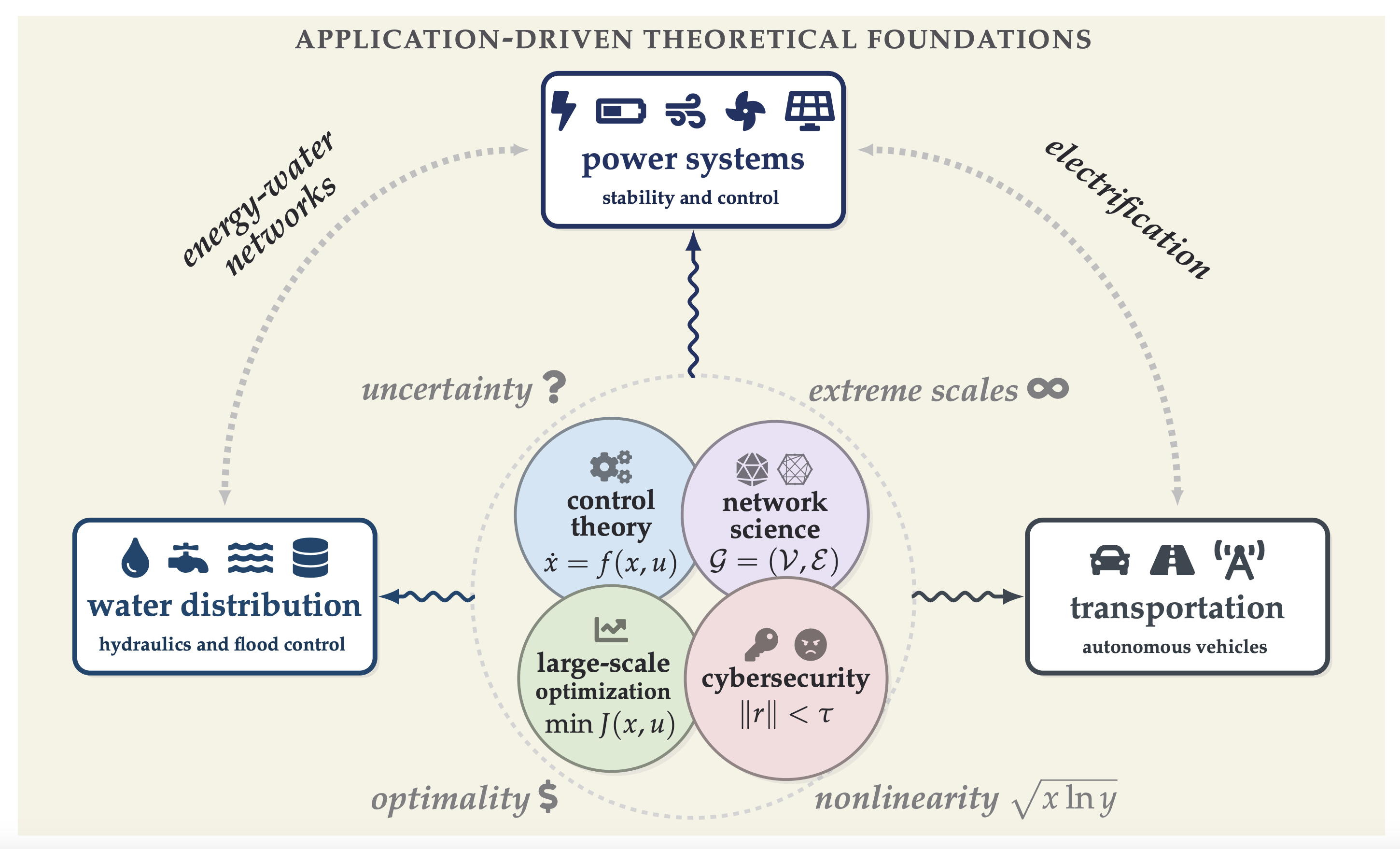
A visual summary of the theoretical foundations and application areas that shape my work on dynamic systems, control, optimization, and infrastructure is included below.
My research develops control-theoretic and optimization methods for large-scale infrastructure systems. The figure below is the rough map I keep coming back to: uncertainty, nonlinearity, scale, networks, and computation on one side; power, water, transportation, security, and climate-aware infrastructure on the other. Most of my publications ask how we can make decisions or certify behavior in systems that are too large, too coupled, or too uncertain for textbook models to behave nicely.
On the theory side, I use tools from control, estimation, convex and nonconvex optimization, graph theory, and dynamical systems to study stability, controllability, observability, sensor placement, state and parameter estimation, cyber-physical security, and robustness. A recurring theme is turning messy infrastructure questions into certificates, bounds, algorithms, or feedback laws that remain useful when models are nonlinear, data is incomplete, and uncertainty refuses to be polite.
On the application side, the publications move between power grids, water distribution and stormwater systems, transportation networks, buildings, and coupled natural-engineered systems. The common thread is large-scale infrastructure: how to monitor it, optimize it, control it, protect it, and understand the failure modes before they become expensive in the real world.